Knowledge Base · A History of Tobago
The IslandEveryone Wanted
Chronology
Five Centuries at a Glance
c. 300 BC – AD 1500
Island of the first peoples
Arawak-speaking peoples, and later the Kalinago (Island Caribs), settled Tobago's valleys and coves. They farmed cassava, fished the reefs and travelled between islands in dugout canoes. Many early Europeans who tried to settle here were driven off by them.
1498
Columbus passes by
On his third voyage, Christopher Columbus sighted the island and, by tradition, called it Bella Forma. He never landed. The name 'Tobago' is usually traced to tobacco, which its people grew and smoked.
1628 – 1630s
The Dutch try first
Merchants from Zeeland sent settlers to found 'Nieuw Walcheren'. Spanish forces from Trinidad and Kalinago resistance wiped out the early settlements.
1642 – 1654
A Baltic duchy in the Caribbean
The Duchy of Courland, a small state in today's Latvia ruled by Duke Jacob Kettler, sent colonists to Great Courland Bay near today's Plymouth. Its fort and town, Jacobusstadt, made Tobago one of the few overseas colonies a Baltic state ever had.
1654 – 1666
Dutch and Courlanders side by side
The Lampsins brothers of Vlissingen built a rival Dutch colony on the other side of the island. In 1662 Louis XIV of France even named Cornelis Lampsins 'Baron of Tobago'.
1666
Buccaneers, then the French
During the Second Anglo-Dutch War, English buccaneers seized the island. The French took it from them, and the Dutch soon returned.
1672
The English strike again
In the Third Anglo-Dutch War, English forces captured Tobago. It later went back to the Dutch.
1677
Two battles in one year
France attacked the Dutch twice in Rockley Bay. The French lost the first battle, and won the second when a single shell hit the Dutch powder magazine. The victors then razed the settlements and left.
1684 – 1748
The 'neutral island'
Britain and France could not agree on who owned Tobago, so it was declared neutral, confirmed again in the Treaty of Aix-la-Chapelle (1748). Neither power would govern it, which made it a haven for pirates, privateers, smugglers and timber cutters.
1763
Britain takes control
The Treaty of Paris handed Tobago to Britain. Land was surveyed and sold as estates, Scarborough was laid out, and the island was rapidly cleared for sugar, cotton and indigo.
1776
A forest set aside
The Main Ridge Forest Reserve was protected by law to preserve the rainfall that fed the island's streams. It is widely regarded as the oldest legally protected rainforest in the Western Hemisphere.
1777
Forts rise, and an estate is born
The British began Fort King George above Scarborough and Fort Milford at Crown Point. In the same year, Little Englishman's Bay Estate was established.
1781
The French invasion
During the American Revolutionary War, a French force under the Marquis de Bouillé landed and forced the British governor to surrender. Scarborough became 'Port Louis' and the fort 'Fort Castries'.
1783
France keeps it
The Treaty of Versailles confirmed Tobago as French. After the French Revolution, the fort was renamed again: Fort République, then Fort Liberté.
1793
Britain returns
British troops recaptured Tobago and restored the name Fort King George.
1802 – 1803
One treaty, one invasion
The Treaty of Amiens gave the island back to France. Barely a year later, war resumed and Britain seized it once more.
1814
The last change of flag
The Treaty of Paris confirmed Tobago as British, ending more than a century and a half of fighting over the island.
1834 – 1838
Emancipation
Slavery was abolished in 1834, followed by a period of 'apprenticeship', and full freedom came in 1838. Many freed families took up small plots of land, and their traditions shape Tobago's culture today.
1847
The great hurricane
A powerful hurricane devastated the island's estates, dealing a heavy blow to an already struggling sugar economy.
1876
The Belmanna Riots
Unrest over working conditions at Roxborough ended with a police corporal named Belmanna being killed. The aftermath led Tobago to give up its old Assembly and become a Crown Colony.
1889 – 1899
Joined to Trinidad
With its sugar trade collapsed, Tobago was joined administratively with Trinidad in 1889, and became a ward of the combined colony in 1899.
1962
Independence
Trinidad and Tobago became an independent nation on 31 August 1962.
1963
Hurricane Flora
Flora tore across Tobago, flattening much of its forest and destroying many of its cocoa, banana and coconut plantations. The island's economy turned increasingly to tourism afterwards.
1980
A voice of its own
The Tobago House of Assembly was re-established, giving the island a measure of self-government once more.
Battles & Sieges
Fought Over, Again and Again
1666
Capture by the English buccaneers
English privateers vs Dutch and Courland colonists
A raid during the Second Anglo-Dutch War took the island, which then passed to France and back to the Dutch within months.
3 March 1677
First Battle of Tobago
Dutch (Jacob Binckes) vs French (Comte d'Estrées)
A brutal fight at close quarters in Rockley Bay. The Dutch held the island, but both fleets lost several ships, among them the French flagship Glorieux, which burned and exploded.
December 1677
Second Battle of Tobago
French (d'Estrées) vs Dutch (Binckes)
The French returned and besieged the fort. A shell landed on the powder magazine, and the explosion killed Binckes and much of his garrison. France won, demolished everything and sailed away.
May – June 1781
French Invasion of Tobago
French (Marquis de Bouillé) vs British (Gov. George Ferguson)
French troops landed at Courland and Scarborough. When a British fleet arrived too late to help, the island surrendered on 2 June 1781.
April 1793
British Capture of Tobago
British (Gen. Cornelius Cuyler) vs French Republic
Early in the French Revolutionary Wars, a British expedition stormed the fort above Scarborough and took the island back.
June 1803
British Capture of Tobago
British (Commodore Samuel Hood, Gen. William Grinfield) vs France
Weeks after war resumed with Napoleon's France, a British force landed and the French garrison surrendered. It was Tobago's final change of hands.
Diplomacy
Won and Lost at the Treaty Table
Pirates, Privateers & Castaways
Where the Law Did Not Reach
A lawless 'neutral island'
For decades after 1684 no nation governed Tobago. Its empty bays became a stopping place for pirates, privateers and smugglers, who came for fresh water, timber and wild game, with no garrison to chase them away.
Privateers with papers
Many of the island's raiders were privateers: private captains licensed by a crown to attack enemy shipping. The capture of 1666 was carried out by English buccaneers, not by a navy.
Robinson Crusoe's island?
Daniel Defoe's Robinson Crusoe (1719) places its castaway on an island near the mouth of the Orinoco, close to Tobago. Tobagonians proudly claim it, and a cave near Crown Point bears Crusoe's name.
Names that tell the tale
Man O' War Bay, Pirate's Bay at Charlotteville and the many cannon still dotting the coast are reminders of how often warships and raiders anchored off these shores.
Stone & Cannon
The Forts of Tobago
Scarborough
Fort King George
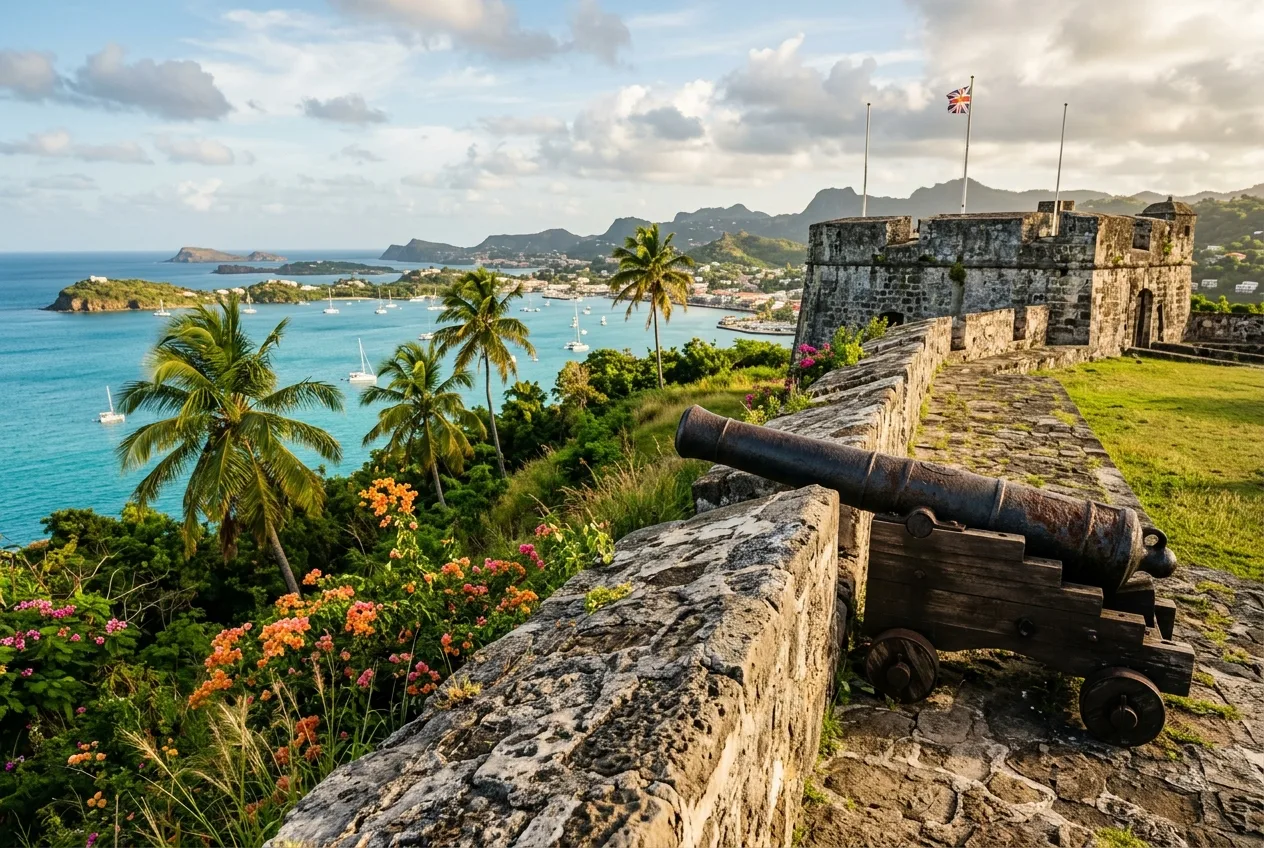
Begun in 1777 on a headland high above Scarborough harbour. It has worn four names under two flags: Fort King George, Fort Castries, Fort République and Fort Liberté. Today it is a museum, with cannon still facing the sea.
Crown Point
Fort Milford
Built by the British in 1777 to guard Store Bay. Its cannon, later used by the French, still point toward the sea near Pigeon Point.
Plymouth
Fort James
Stands near the spot where the Courlanders built their first fort at Great Courland Bay. The present stone fort dates from the British era.
Black Rock
Fort Bennett
A battery built during the wars of the late 1700s, overlooking Great Courland Bay.
Studley Park
Fort Granby
A small British fort on the windward coast, guarding the approaches to the island's eastern bays.
Cocoa & Trade
Sugar, Cocoa and the Trade Winds
Trinitario: born next door
After a blight struck Trinidad's cocoa in the 1720s, hardy Forastero trees were brought in and crossed naturally with the surviving Criollo. The result was Trinitario, now grown around the world and prized for its flavour.
From sugar to cocoa
Sugar made Tobago one of Britain's richest small colonies in the late 1700s. After emancipation, hurricanes and falling prices, cocoa, coconuts and limes took over the island's estates in the late 1800s.
Fine or flavour, officially
The International Cocoa Organization recognises Trinidad and Tobago as an exporter of fine or flavour cocoa, a category reserved for beans with distinctive aroma and taste.
A global gene bank
The International Cocoa Genebank at the University of the West Indies in Trinidad holds one of the world's largest collections of cocoa varieties, studied by breeders worldwide.
The storm that changed everything
Hurricane Flora in 1963 destroyed much of Tobago's cocoa. Many estates were abandoned, and some of those old groves are now being revived for fine chocolate.
Trade winds and trade routes
Tobago's position upwind of the other islands made it a strategic prize: ships sailing from Europe could reach it first, and whoever held it could watch the approaches to the Spanish Main.
Did You Know?
Things Most Visitors Never Hear
Tobago changed hands more than 30 times, a record often said to be unmatched in the Caribbean.
A tiny Baltic duchy in today's Latvia once ran a colony here, and a monument in Plymouth still honours the Courlanders.
Louis XIV once made a Dutch merchant 'Baron of Tobago'.
In 1677 a single French shell landed on a powder magazine and decided the fate of the island.
Scarborough was briefly renamed 'Port Louis' by the French.
Fort King George has had four names under two flags.
The Main Ridge was protected in 1776, the same year as the American Declaration of Independence.
In 1909 Sir William Ingram released greater birds-of-paradise from New Guinea on Little Tobago, hoping to save them from the plume trade.
Little Tobago is now one of the Caribbean's most important seabird sanctuaries.
Speyside's reefs host what is often described as one of the largest brain corals in the region.
A gravestone in Plymouth, dated 1783, carries the riddle: 'She was a mother without knowing it, and a wife without letting her husband know it.' Its meaning is still debated.
Tobago's national bird, the cocrico, is famous for its loud dawn chorus.
In 2020 UNESCO named north-east Tobago a Man and the Biosphere Reserve.
Trinitario cocoa, now grown worldwide, was born in Trinidad and Tobago.
Come and See It for Yourself
Explore the Nature Park and the River and Waterfalls Trail. Discover a cocoa heritage centuries in the making, and stand on a shore that has watched empires come and go. Few places let you walk through so much history and so much natural beauty in a single day.